Often, yes. People taking GLP-1 medications like Ozempic, Wegovy, Mounjaro and Zepbound eat considerably less, and in a study of more than 460,000 people starting these drugs, vitamin D deficiency was the single most common deficiency diagnosed in the first year of treatment. Less food means less vitamin D coming in, and smaller, lighter meals mean less of the fat vitamin D needs to be absorbed.
If you're on a GLP-1, or about to start one, this is one of the easiest gaps to close. Here's why it happens, what the research shows, and what to do about it.
Key takeaways
- In a study of 461,382 adults newly prescribed GLP-1s, vitamin D deficiency was the most common nutritional deficiency diagnosed, reaching 13.6% within 12 months.
- GLP-1s can cut daily food intake by as much as 39%, and very few foods contain meaningful vitamin D to begin with.
- Vitamin D is fat-soluble. Taken with a meal that contains fat, it produced a 32% higher peak in blood levels than with a fat-free meal.
- In the same study, fewer than 1 in 10 adults had seen a dietitian in the six months before starting a GLP-1.
- A 25-hydroxyvitamin D blood test tells you where you stand. A daily dose in an oil base brings its own fat, regardless of how much you ate.
WHY DO PEOPLE ON GLP-1S RUN LOW ON VITAMIN D?
Because the medication works exactly as intended. GLP-1s turn down appetite and make you feel full sooner and for longer. Studies of these drugs have reported reductions in daily energy intake of up to 39%. That's the point of the medication. But every vitamin and mineral you get from food shrinks along with it.
Vitamin D was already the hardest of them to get from food. Almost nothing you eat carries meaningful amounts: fatty fish, egg yolks, and milk that has had it added. That's why most people rely on sunlight for the bulk of theirs. Eat a third less, and a thin supply gets thinner.
Many people also start a GLP-1 already low. Vitamin D is stored in fat tissue, so the more body fat someone carries, the less of it stays in circulation. We covered that in detail in the overlooked vitamin holding back your weight loss. The researchers behind that 461,382-person study pointed to the same thing: vitamin D deficiency is common in this group because of storage in fat tissue and limited sun exposure, and it may get worse during weight loss unless it's adequately supplemented.
Then there's the calendar. If you're starting or continuing a GLP-1 this fall, you're heading into the months when the sun stops helping. Above roughly 37 degrees latitude, skin makes little to no vitamin D from November through February. More on that in when to start taking vitamin D for winter.
WHAT DOES THE RESEARCH SHOW ABOUT GLP-1S AND VITAMIN D?
The clearest data comes from large insurance-claims studies that track what gets diagnosed after people start these medications.
The biggest of these, published in Obesity Pillars in 2025, followed 461,382 adults newly prescribed a GLP-1, none of whom had a nutritional deficiency on record beforehand. Within a year, 22.4% had been diagnosed with some kind of nutritional deficiency. Vitamin D was the most common by a wide margin: 7.5% within six months and 13.6% within twelve. When the researchers compared people on a GLP-1 plus metformin against closely matched people on metformin alone, the GLP-1 group had significantly more vitamin D deficiency at 12 months.
| Study | Who was studied | What it found on vitamin D |
|---|---|---|
| Butsch et al., Obesity Pillars, 2025 | 461,382 adults newly prescribed a GLP-1 | Most common deficiency diagnosed: 7.5% at 6 months, 13.6% at 12 months |
| Same study, matched comparison | 4,505 on a GLP-1 plus metformin vs 4,505 on metformin alone | 10.9% vs 9.2% diagnosed at 12 months |
| US claims analysis, 2025 (preprint) | 18,746 adults with type 2 diabetes | 49% higher risk of vitamin D deficiency than people on SGLT2 inhibitors, 32% higher than DPP-4 inhibitors |
| Kerr et al., Childhood Obesity, 2026 | 2,031 patients aged 10 to 17 on a GLP-1 | 12.4% diagnosed with vitamin D deficiency within one year, the most common deficiency |
One thing to keep in mind when reading these numbers: they only count people who were tested and diagnosed. The authors of the 461,382-person study noted that nutritional deficiencies are often underdiagnosed and that their figures likely capture only the minimum. Vitamin D isn't on a standard blood panel, and roughly 70% of US adults are already below the level considered sufficient. The true share of GLP-1 users running low is almost certainly higher than what shows up in the records.
The medical community has noticed. In May 2025, four major professional groups in obesity medicine and nutrition published a joint advisory on nutritional priorities for people on GLP-1 therapy, with the lead author naming nutrient deficiencies as one of the pitfalls a structured approach is meant to avoid. Yet in the 461,382-person study, fewer than 1 in 10 adults had seen a dietitian in the six months before starting treatment, and in the pediatric study only 5% received nutritional counseling within the first month.
Vitamin D deficiency was the most common nutritional deficiency diagnosed in the first year on a GLP-1, and those numbers only count the people who got tested.
DOES EATING LESS FAT AFFECT VITAMIN D ABSORPTION?
Yes, and this is the part most people on a GLP-1 never hear about.
Vitamin D is fat-soluble. It's absorbed in the gut along with dietary fat, not dissolved in water. In a controlled trial, taking vitamin D3 with a meal that contained fat produced a 32% higher peak in blood levels than taking the same dose with a fat-free meal. We went through the mechanism in why vitamin D needs fat to be absorbed.
Now think about what a typical day on a GLP-1 looks like. Meals get smaller. Many people eat less often. And rich, greasy food is one of the most common things people on these medications learn to avoid, because it tends to sit heavily. So a dry vitamin D tablet taken with half a piece of toast, or a coffee in place of breakfast, has very little fat to be absorbed alongside.
Most advice about taking vitamin D assumes a normal breakfast. On a GLP-1, that's exactly the assumption that stops being true.
SHOULD YOU TEST YOUR VITAMIN D ON A GLP-1?
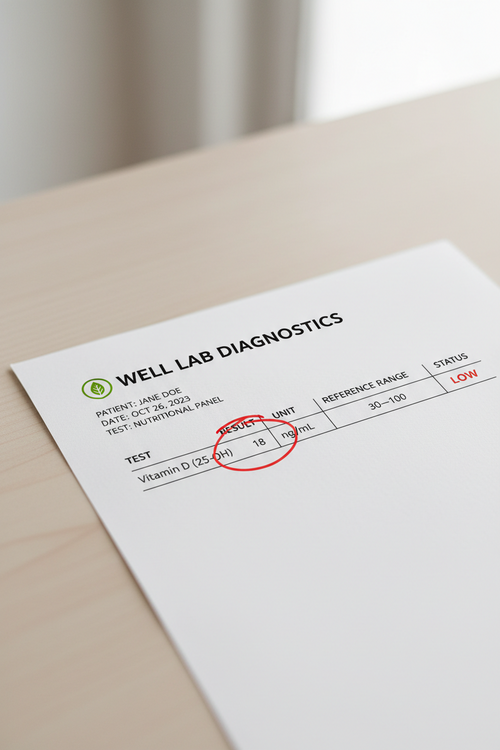
It's worth it, and you're in a better position than most people to get it done. You're already seeing a prescriber and having bloodwork, so ask for a 25-hydroxyvitamin D test to be added to your next panel. The researchers behind the 461,382-person study listed it among the standard labs for screening nutrient gaps in this group.
Here's how to read the result, using the thresholds from the Endocrine Society's 2011 guideline:
| 25(OH)D level | What it means |
|---|---|
| Below 20 ng/mL | Deficient |
| 20 to 29 ng/mL | Insufficient |
| 30 ng/mL and above | Sufficient |
If you start supplementing, retest after about three months. Circulating vitamin D has a half-life of roughly 15 days, so it takes that long for levels to settle at a new steady state. If your number comes back low, here's what to do next.
You don't need a test to start a moderate daily dose, though. For healthy adults, 2,000 IU a day sits at half the 4,000 IU upper limit set by the National Academies, and it was taken daily for more than five years by over 25,000 people in the VITAL trial. More on where the real limits are in can you take too much vitamin D. As with any supplement, let your prescriber know what you're taking.
HOW MUCH VITAMIN D DO PEOPLE ON GLP-1S TAKE?
There's no GLP-1-specific dose, so the general guidance applies. 2,000 IU a day is a well-studied, low-risk daily amount that works for most adults as a baseline.
People carrying more body weight often need more to reach the same blood level. The Endocrine Society's 2011 guideline suggested adults with significant excess weight may need two to three times more vitamin D than other adults, which is exactly why a test is useful: it lets you and your doctor adjust from a real number rather than a guess. Liquid drops make that easy, since you can change the amount without buying a different product. Full ranges are in how much vitamin D should you take.
WHAT KIND OF VITAMIN D SUPPLEMENT MAKES SENSE WHEN YOUR APPETITE IS LOW?
The form matters more on a GLP-1 than it does for almost anyone else, because the usual safety net, a decent meal, isn't reliably there. Here's what to look for.
It brings its own fat. Vitamin D suspended in an oil carries the fat it needs with every dose, so absorption doesn't depend on what you managed to eat that morning. A dry tablet or powder-based capsule does depend on it.
It's small. When your appetite is down, nobody wants another large pill or something that takes up room. A single dropper of liquid is about as small as a daily dose gets.
It has no added sugar. Many people on GLP-1s are also watching their blood sugar. Gummies usually contain added sugar, which we compared in vitamin D gummies vs liquid drops.
It fits a routine you already have. Consistency decides whether any of this works. A dose taken every day beats a larger dose taken whenever you remember. Tie it to something that happens every morning, like your coffee, and it stops being something you have to think about.
That's the product we built. D3X vitamin D3 + K2 has three ingredients: vitamin D3, vitamin K2 as MK-7, and organic olive oil. Each 1 mL dropper delivers 2,000 IU of D3 and 100 mcg of K2, with no sugar, no fillers and no seed oils. Because it's already in olive oil, the fat comes with every dose. It goes straight onto the tongue, onto a spoon, or into your morning coffee.*
WHY TAKE VITAMIN K2 WITH VITAMIN D?
Vitamin D increases how much calcium you absorb from food. Vitamin K2 activates the proteins that help direct that calcium into bone.* The two work as a pair, which is why we put them in the same dropper. When you're changing how much you eat, and what you eat, supporting healthy bones is worth keeping in mind.* Here's why we pair K2 with vitamin D3.
WHAT SHOULD YOU DO IF YOU'RE ON A GLP-1?
Ask for a vitamin D test at your next check-in. It's a standard 25-hydroxyvitamin D test any prescriber can add.
Take vitamin D every day, not just when you remember. A 15-day half-life means consistency matters more than dose size.
Choose a form that brings its own fat, so absorption doesn't depend on the size of your meals.
Anchor it to your morning. Same time, same place, every day.
A GLP-1 changes how much you eat. It shouldn't quietly change how much vitamin D you get. D3X is one dropper a day, in olive oil, and the subscription ships before you run out, so staying consistent through the winter isn't something you have to remember.
*These statements have not been evaluated by the Food and Drug Administration. This product is not intended to diagnose, treat, cure, or prevent any disease.
Sources
Butsch WS, Sulo S, Chang AT, et al. "Nutritional deficiencies and muscle loss in adults with type 2 diabetes using GLP-1 receptor agonists: a retrospective observational study." Obesity Pillars, 2025.
Kerr KW, Chang AT, Sulo S, et al. "Nutritional deficiencies, complications, and nutrition therapy/counseling in pediatric patients using GLP-1 receptor agonists." Childhood Obesity, 2026.
"Real-world comparative outcomes of GLP-1 RA and semaglutide prescription among individuals with type 2 diabetes." medRxiv, 2025 (preprint).
Mozaffarian D, et al. "Nutritional priorities to support GLP-1 therapy for obesity." Joint advisory of the American College of Lifestyle Medicine, American Society for Nutrition, Obesity Medicine Association and The Obesity Society, 2025.
Dawson-Hughes B, et al. "Dietary fat increases vitamin D-3 absorption." Journal of the Academy of Nutrition and Dietetics, 2015.
Holick MF, et al. "Evaluation, treatment, and prevention of vitamin D deficiency: an Endocrine Society clinical practice guideline." Journal of Clinical Endocrinology & Metabolism, 2011.
Manson JE, et al. "Vitamin D supplements and prevention of cancer and cardiovascular disease." New England Journal of Medicine, 2019.
Institute of Medicine. "Dietary Reference Intakes for Calcium and Vitamin D." National Academies Press, 2011.
Frequently Asked
Do people on GLP-1 medications need vitamin D?
Many do. In a study of 461,382 adults newly prescribed a GLP-1, vitamin D deficiency was the most common nutritional deficiency diagnosed, reaching 13.6% within 12 months. GLP-1s reduce how much you eat, very few foods contain vitamin D, and smaller meals supply less of the fat vitamin D needs to be absorbed.
Why do Ozempic and Mounjaro users run low on vitamin D?
GLP-1 medications reduce appetite, with studies reporting drops in daily energy intake of up to 39%. Vitamin D is already scarce in food, so eating less shrinks an already thin supply. Many people also start treatment low, since vitamin D is stored in fat tissue, and in fall and winter the sun adds little or nothing.
Does a GLP-1 affect how well you absorb vitamin D?
Vitamin D is fat-soluble and absorbed along with dietary fat. In one trial, taking vitamin D3 with a fat-containing meal produced a 32% higher peak in blood levels than a fat-free meal. On a GLP-1, meals tend to be smaller and lower in fat, so a vitamin D supplement in an oil base, which brings its own fat, is a practical choice.
Should I get my vitamin D tested while on a GLP-1?
It's worth asking your prescriber to add a 25-hydroxyvitamin D test to your next blood panel. By the Endocrine Society's 2011 thresholds, below 20 ng/mL is deficient, 20 to 29 is insufficient, and 30 ng/mL or above is sufficient. If you start supplementing, retest after about three months.
How much vitamin D should I take on a GLP-1?
There's no GLP-1-specific dose. 2,000 IU a day is a well-studied, low-risk baseline for healthy adults: it is half the 4,000 IU upper limit and was taken daily for over five years by more than 25,000 people in the VITAL trial. People carrying more weight often need more to reach 30 ng/mL, so a blood test helps you and your doctor adjust. Let your prescriber know what supplements you take.
What is the best form of vitamin D when your appetite is low?
Look for a small dose that brings its own fat and has no added sugar. D3X vitamin D3 + K2 is 2,000 IU of D3 and 100 mcg of K2 in one 1 mL dropper of organic olive oil, so absorption doesn't depend on the size of your meal. It can be taken on the tongue, on a spoon, or in morning coffee.