Vitamin D3 raises how much calcium your body absorbs. Vitamin K2 controls where that calcium goes, steering it toward bone instead of arteries and soft tissue.* And because both are fat-soluble, taking them together in an oil base helps your body actually absorb each one. That last part is the reason the pairing works, and it is the part almost every article leaves out.
The short version:
- D3 gets calcium into your blood. K2 gets it into your bones.*
- High-dose D3 without K2 leaves that extra calcium without a traffic cop.
- Both vitamins are fat-soluble, so the carrier matters as much as the combo.
- MK-7 is the K2 form worth looking for.
WHAT VITAMIN D3 ACTUALLY DOES
Start with the job everyone knows D3 for. According to the NIH Office of Dietary Supplements, vitamin D's main role is helping your gut absorb calcium. The NIH calcium fact sheet puts it plainly: vitamin D is required for calcium to be absorbed in the gut. Without enough D, you can eat all the calcium you want and absorb only a fraction of it.
So D3 turns up the calcium supply. Good. But that is only half of a system, and the other half is where most supplements go quiet.
WHAT VITAMIN K2 DOES
Vitamin K2 is the part that decides where the calcium ends up. It activates two proteins, osteocalcin and matrix Gla protein, and those proteins are what bind calcium into bone and keep it out of your arteries.* In the words of the research, K2 converts the inactive forms of these proteins into their active forms, helping deposit calcium in bone and helping prevent it from building up in blood vessels.*
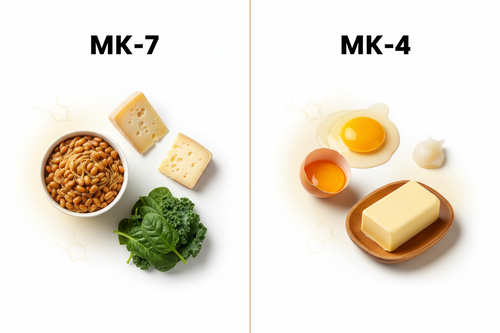
Not all K2 is equal. The form called MK-7 is the one to look for. It stays active in your body far longer than other forms and carries out that protein activation at everyday doses, which is why researchers point to MK-7 for bone quality.*
| K2 form | Stays active | What that means for you |
|---|---|---|
| MK-4 | Hours | Needs large, frequent doses to keep working |
| MK-7 | Days | Active at everyday doses. The form to look for |
WHY THEY WORK TOGETHER
Put the two jobs side by side and the pairing explains itself. D3 increases the calcium in your bloodstream. K2 makes sure that calcium is directed into bone rather than left to settle in soft tissue. One brings the calcium in. The other tells it where to go.
| Vitamin D3 | Vitamin K2 (MK-7) | |
|---|---|---|
| Main job | Increases calcium absorption | Directs calcium into bone |
| Works through | Calcium uptake in the gut | Osteocalcin and matrix Gla protein |
| Where calcium ends up | Into your blood | Into bone, not arteries |
| Missing it means | You absorb little calcium | Calcium moves without direction |
Vitamin D controls how much calcium you absorb. Vitamin K2 controls where it goes. And because both are fat-soluble, the oil they are delivered in controls whether you absorb either one.
That is the mechanism every article gets right. Here is the one they miss.
THE PART EVERY OTHER ARTICLE SKIPS: BOTH ARE FAT-SOLUBLE
D3 and K2 are both fat-soluble vitamins. That is not a footnote. It is the difference between a supplement that gets absorbed and one that mostly passes through you. Fat-soluble means your body needs fat present to carry these vitamins across the gut wall.
The research is specific about it. In a Tufts University study published in the Journal of the Academy of Nutrition and Dietetics, peak vitamin D3 absorption was significantly higher when the dose was taken with a fat-containing meal than with a fat-free one.
Now look at how most D3 and K2 products are sold. Gummies, which are mostly sugar and water. Dry tablets and capsules with no fat in sight. You are being handed two fat-soluble vitamins with nothing to carry them. The combination is right and the delivery is working against it.
This is the whole reason D3X puts its D3 and K2 in organic olive oil. The fat is not a flourish. It is the carrier the two vitamins need to be absorbed, built into the format instead of left up to whether you happened to eat something oily.
HOW MUCH K2 WITH D3
A sensible daily pairing is around 2,000 IU of vitamin D3 with roughly 100 mcg of K2 as MK-7. That is the ratio D3X is built around, and it lines up with the MK-7 doses used in the bone research. The exact number you need depends on your own levels, so if you are correcting a known shortfall, test with your provider rather than guessing.
The takeaway is simpler than the math: you want both, in a form your body absorbs, in roughly this proportion, every day. Consistency does more than any single large dose.
IS HIGH-DOSE D3 WITHOUT K2 A PROBLEM?
This is the honest reason the pairing gets recommended. When you push vitamin D up, you increase calcium absorption. Without enough K2 to activate the proteins that route that calcium, more of it is left circulating. K2's matrix Gla protein is one of the body's tools for keeping calcium out of soft tissue.* Pairing K2 with your D3 is the straightforward way to keep the system in balance. If you are on higher-dose vitamin D or take blood thinners, talk to your provider before changing anything, since vitamin K interacts with those medications.
None of this is exotic. It is just the second half of a system most bottles only sell you the first half of. Get both, in a form you absorb, and take it consistently.
Sources
National Institutes of Health, Office of Dietary Supplements. "Vitamin D: Fact Sheet for Health Professionals."
National Institutes of Health, Office of Dietary Supplements. "Calcium: Fact Sheet for Health Professionals."
National Institutes of Health, Office of Dietary Supplements. "Vitamin K: Fact Sheet for Health Professionals."
Dawson-Hughes B, et al. "Dietary Fat Increases Vitamin D-3 Absorption." Journal of the Academy of Nutrition and Dietetics, 2015.
Akbari S, Rasouli-Ghahroudi AA. "Vitamin K and Bone Metabolism: MK-7, Osteocalcin and Matrix Gla Protein." (review).
Mladěnka P, et al. "MK-7 and Its Effects on Bone Quality and Strength." Nutrients, 2020.
About D3X. D3X makes one thing: a clean liquid vitamin D3 + K2 (2,000 IU D3 / 100 mcg K2) in an olive-oil base, third-party tested and made in the USA. No seed oils, fillers, or sweeteners. Learn more.
*These statements have not been evaluated by Food and Drug Administration. This product is not intended to diagnose, treat, cure, or prevent any disease.
Frequently Asked
Why should you take K2 with vitamin D3?
Vitamin D3 increases how much calcium your body absorbs, and vitamin K2 activates the proteins that direct that calcium into bone and away from arteries and soft tissue.* Taking them together keeps the calcium D3 brings in moving to the right place.
Can you take vitamin D3 without K2?
You can, but pairing them is the common recommendation. When vitamin D raises calcium absorption, K2 helps route that calcium into bone rather than leaving more of it circulating.* If you take higher-dose vitamin D or blood thinners, check with your provider first.
How much K2 should you take with vitamin D3?
A common daily pairing is about 2,000 IU of vitamin D3 with roughly 100 mcg of K2 as MK-7. Your ideal vitamin D amount depends on your own levels, so test with a provider if you are correcting a known shortfall.
What form of K2 is best to take with D3?
MK-7 is the form most often recommended. It stays active in the body longer than other forms of K2 and activates the relevant proteins at everyday doses.*
Is it better to take D3 and K2 as a liquid or a capsule?
Both D3 and K2 are fat-soluble, so they absorb better in the presence of fat. A liquid in an oil base supplies that fat directly, while a gummy or dry tablet does not, which is why the carrier format matters.