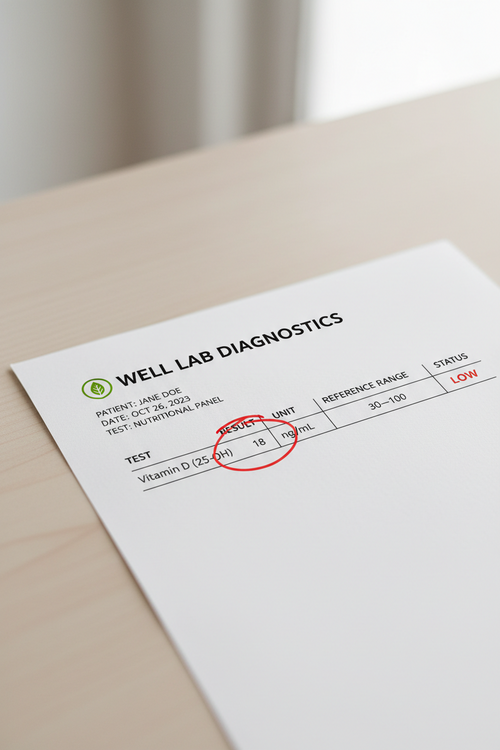
Roughly 70% of US adults have insufficient vitamin D levels, according to a 2018 NHANES analysis of 26,010 adults.
Seven in ten.
The figure comes from NHANES, the federal health and nutrition survey, run through Endocrine Society cutoffs. Almost three-quarters of US adults fall below the level researchers consider sufficient. And almost no one is testing for it.
WHAT THE NUMBERS ACTUALLY SHOW
The 2018 NHANES analysis published in the British Journal of Nutrition drew on 26,010 US adults across a decade of national survey data. Under the Endocrine Society's clinical cutoffs, it found 28.9% with serum 25(OH)D below 50 nmol/L (20 ng/mL) and 41.4% between 50 and 75 nmol/L. Combined: 70.3%.
The global picture is even bigger. A 2023 pooled analysis of 7.9 million people from 81 countries found 47.9% of the world has vitamin D levels below 50 nmol/L, and 76.6% below 75 nmol/L. Three out of four people worldwide fall below what the Endocrine Society considers sufficient.
One of the most-cited vitamin D researchers of the last 40 years, Dr. Michael Holick, has called it "certainly the most common nutritional deficiency and likely the most common medical problem in the world", estimating 1.5 to 2 billion people globally fall below sufficient levels.
HOW IT GOT THIS BAD
The biology hasn't changed. The environment has.
Vitamin D production runs on UVB light hitting skin. The body was tuned, over hundreds of thousands of years, to a default of outdoor daylight exposure. Now: indoor jobs, indoor entertainment, sunscreen on every exposed inch in summer, screens in every spare minute. The 2023 global analysis found insufficiency rates in winter and spring were 1.7 times higher than in summer and autumn. Latitude matters too. Populations in high-latitude regions showed substantially worse numbers.
The NHANES analysis found insufficiency rates were higher in non-Hispanic Black adults, Hispanic adults, adults with higher BMI, smokers, and people who were physically inactive. Darker skin requires more UVB exposure to produce the same amount of vitamin D. Biology meeting modern indoor life.
WHY ALMOST NO ONE KNOWS
Vitamin D is not part of the standard annual checkup blood panel. Most people only find out they're low because they ask, or because something else prompts a test.
The symptoms of running low are diffuse. Low energy, poor sleep, low mood, slow recovery from training.* None of it is dramatic. None of it is specific. It blends into stress, into season, into life. So even people running well below sufficient often have no idea, and no reason to suspect, that a foundational nutrient is the variable.
WHAT FOUNDATIONAL ACTUALLY MEANS
Vitamin D plays a role in calcium absorption and bone mineralization.* Receptors for it are found in nearly every tissue in the body, and it functions more like a hormone than a typical vitamin.* The breadth of those roles is part of why researchers now treat vitamin D as foundational rather than peripheral.
When most of a population is running low on a nutrient the body was designed to make from sunlight, the public health picture changes. The fix is not complicated. The first step is knowing where you stand. A 25-hydroxy vitamin D blood test, the standard 25-OH panel any doctor can order, tells you what your level actually is.
Time to get serious about your D. Stop being part of the 70%.
Frequently Asked
What percentage of Americans are low on vitamin D?
Roughly 70% of US adults have insufficient vitamin D levels, according to a 2018 NHANES analysis of 26,010 adults published in the British Journal of Nutrition. Under Endocrine Society clinical cutoffs, 28.9% had levels below 50 nmol/L and 41.4% had levels between 50 and 75 nmol/L. Combined: 70.3% fell below the threshold considered sufficient.
How common is vitamin D insufficiency globally?
A 2023 pooled analysis of 7.9 million people from 81 countries found 47.9% of the world has vitamin D levels below 50 nmol/L, and 76.6% below 75 nmol/L, which is the Endocrine Society's threshold for sufficient. Researchers estimate 1.5 to 2 billion people worldwide fall below sufficient levels.
Why are so many people low on vitamin D?
Vitamin D production depends on UVB sunlight hitting skin, but indoor lifestyles, sunscreen use, screens, latitude, and season all reduce that exposure. The 2023 global analysis found insufficiency rates in winter and spring were 1.7 times higher than in summer and autumn. NHANES data also found higher insufficiency rates in adults with darker skin, higher BMI, and lower physical activity.
Why don't more people know they're low on vitamin D?
Vitamin D is not part of the standard annual checkup blood panel in most clinical settings. People usually only find out they're low because they specifically ask, or because something else prompts a test. The symptoms of running low are diffuse: low energy, poor sleep, low mood, slow recovery.* They're easy to blame on other things.
How do I find out if I'm low on vitamin D?
A 25-hydroxy vitamin D blood test (the standard 25-OH panel) is the test most clinicians use. Any doctor can order it. Under Endocrine Society cutoffs, levels below 50 nmol/L (20 ng/mL) are considered deficient, 50-75 nmol/L is insufficient, and above 75 nmol/L is sufficient.