Vitamin D deficiency is not evenly distributed. Some people are far more likely to end up low, and the reasons are specific and mostly known.
Roughly 70% of US adults sit below the level considered sufficient, based on a 2018 analysis of 26,010 adults in the British Journal of Nutrition. But that average hides the part worth knowing, which is who carries most of the risk.
Your level is the result of three inputs: what your skin makes from sunlight, what you eat, and what you supplement. Sunlight normally does most of the work. Deficiency happens when that pathway gets blocked and nothing replaces it.
WHO IS MOST AT RISK OF VITAMIN D DEFICIENCY?
| Risk factor | Why it lowers your level | What helps |
|---|---|---|
| Darker skin | Melanin absorbs UVB, so the same sun exposure produces less vitamin D | Longer exposure or supplementation; testing is more informative here |
| Living above about 37°N | Winter sun sits too low for UVB to reach skin at all | Year-round supplementation through the winter months |
| Indoor work | The UVB window is roughly 10am to 2pm, spent inside | Midday outdoor time, or a daily dose |
| Higher body fat | Vitamin D is fat-soluble and distributes into adipose tissue | Dose may need to be higher; worth testing rather than guessing |
| Older age | Skin holds less of the precursor UVB converts | Consistent daily intake rather than relying on sun |
| Consistent sunscreen use | SPF 8 and above blocks the UVB used for synthesis | A dose that does not depend on sun exposure |
| Fat malabsorption conditions | Less dietary fat absorbed means less vitamin D absorbed with it | A conversation with your provider about form and dose |
Most people carry more than one of these. An office worker in Chicago who uses sunscreen has three.
DOES SKIN TONE AFFECT VITAMIN D?
Yes, and it is one of the larger effects. Melanin is effective at absorbing UVB, which is what makes it protective against sun damage. The same property means less UVB reaches the cells that convert the precursor molecule into vitamin D.
The practical result is that the same time outdoors produces less vitamin D. NHANES data found higher rates of insufficiency in US adults with darker skin. This is a difference in how much sun is needed, not a difference in how the vitamin works once it is in you.
WHY DOES LATITUDE MATTER SO MUCH?
Because UVB has to pass through the atmosphere at a steep enough angle to reach you at all.
A 1988 study by Webb, Kline and Holick measured vitamin D synthesis in winter sunlight and found that skin in Boston, at 42.2°N, produced no measurable previtamin D3 from November through February. In Edmonton, at 52°N, that window ran October through March. Holick has summarized it plainly: in Boston you cannot make vitamin D in your skin from November through March no matter how long you stay outside.
Most of the US population lives above 37°N. For a large share of the country, winter sun is not a source of vitamin D at any duration. We went through whether you can get enough from the sun in more detail.
You can spend all afternoon in January sunlight in Boston and make nothing.
DOES BODY WEIGHT AFFECT VITAMIN D LEVELS?
It does. Vitamin D is fat-soluble and distributes into fat tissue, which means more body fat leaves less circulating in the blood where a test measures it.
A 2000 study by Wortsman and Holick in the American Journal of Clinical Nutrition found that participants with obesity showed a 57% lower rise in circulating vitamin D after UVB exposure than lean participants, despite similar precursor levels in the skin. Researchers still debate whether the mechanism is sequestration in fat tissue or dilution across a larger body volume. The practical outcome is the same: the same input produces a lower reading.
IS VITAMIN D DEFICIENCY GENETIC?
Partly. Variation in the genes affecting vitamin D binding protein and the enzymes that metabolize it influences how individuals respond to the same intake. This is one reason two people can take an identical dose and land at different levels.
It is not a large enough factor to override the behavioral and environmental ones above, and there is no routine clinical test for it. It is a reason to check your own number rather than assume a standard dose lands you in the same place it lands someone else.
HOW DO YOU KNOW IF YOU ARE DEFICIENT?
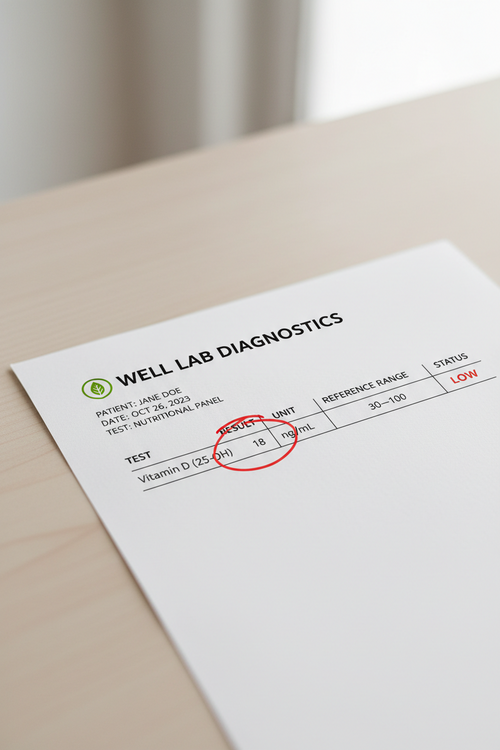
A serum 25-hydroxyvitamin D test, written 25(OH)D. It is a standard panel any provider can order, and it is not usually part of a routine annual physical, so you generally have to ask.
Symptoms are not a reliable substitute. Many people who are low notice nothing at all, and the things people do notice are vague enough to have many other causes. If your result comes back low, we covered what the number actually means and what to do about it.
WHAT IF YOU ARE IN SEVERAL RISK GROUPS?
The factors stack. Darker skin plus a northern winter plus indoor work is not three small effects, it is three blockages on the same pathway.
The useful response is not to fix your latitude or your job. It is to stop depending on a pathway that is closed for you and supply the vitamin directly, consistently, in a form that absorbs. Vitamin D is fat-soluble, so it needs fat present to be taken up properly, which is why the carrier matters and why oil-based forms outperform dry tablets and gummies.
That is the reasoning behind D3X: liquid D3 and K2 in organic olive oil, so the fat that drives absorption arrives with every dose rather than depending on what you had for breakfast.* Three ingredients, no fillers, one dropper a day.
If you are in two or more of the groups above, the question is not really whether to supplement. It is whether you will still be doing it in three months.
Sources
Liu X, et al. "Vitamin D deficiency and insufficiency among US adults: prevalence, predictors and clinical implications." British Journal of Nutrition, 2018. n=26,010.
Webb AR, Kline L, Holick MF. "Influence of season and latitude on the cutaneous synthesis of vitamin D3." Journal of Clinical Endocrinology and Metabolism, 1988.
Wortsman J, et al. "Decreased bioavailability of vitamin D in obesity." American Journal of Clinical Nutrition, 2000.
Frequently Asked
What causes vitamin D deficiency?
Most deficiency comes from blocked sunlight synthesis without dietary or supplemental replacement. The main drivers are darker skin, living at higher latitudes, indoor work during midday hours, higher body fat, older age, consistent sunscreen use, and conditions affecting fat absorption.
Who is most at risk of vitamin D deficiency?
People with several risk factors at once. Darker skin, northern latitude, and indoor work stack rather than offset each other. NHANES data found higher insufficiency rates in US adults with darker skin, higher BMI, and lower physical activity.
Does skin tone affect vitamin D levels?
Yes. Melanin absorbs UVB, which is what makes it protective against sun damage, and the same property means less UVB reaches the cells that make vitamin D. The same time outdoors produces less vitamin D, so more exposure or supplementation is needed to reach the same level.
Can you make vitamin D in winter?
It depends on latitude. Webb, Kline and Holick found skin in Boston at 42.2°N produced no measurable previtamin D3 from November through February, and in Edmonton at 52°N that window ran October through March. Most of the US population lives above 37°N.
Does being overweight affect vitamin D levels?
Vitamin D is fat-soluble and distributes into fat tissue, leaving less circulating in blood. A 2000 study in the American Journal of Clinical Nutrition found a 57% lower rise in circulating vitamin D after UVB exposure in participants with obesity compared with lean participants.
Is vitamin D deficiency hereditary?
Genetic variation in vitamin D binding protein and metabolizing enzymes influences how people respond to the same intake, which is part of why identical doses produce different levels. It is a smaller factor than behavior and environment, and there is no routine clinical test for it.
How is vitamin D deficiency diagnosed?
With a serum 25-hydroxyvitamin D blood test, written 25(OH)D. Any provider can order it, and it is not typically included in a routine annual panel, so it usually has to be requested. Symptoms alone are not reliable, since many people who are low notice nothing.