Most healthy adults need 600 to 800 IU of vitamin D per day, and the safe daily upper limit is 4,000 IU, according to the National Institutes of Health.
So why do half the bottles on the shelf say 5,000 or 10,000?
Because a big number sells. The dose that's right for you depends on where you're starting from, but the ranges are well defined, and more is not automatically better. Here's how to think about it.
THE OFFICIAL NUMBERS
The NIH recommended dietary allowance is 600 IU per day for adults aged 1 to 70, and 800 IU for adults over 70. The tolerable upper limit, the most you should take daily without medical supervision, is 4,000 IU.
Notice the gap between those two numbers. There's a wide, safe range between the minimum and the ceiling.
WHAT THE LATEST GUIDANCE SAYS
In 2024, the Endocrine Society published a clinical guideline in The Journal of Clinical Endocrinology and Metabolism on vitamin D and disease prevention. Two takeaways are worth knowing.
First, for generally healthy adults under 75, the panel found little trial evidence that taking more than the recommended allowance prevents disease. Second, they flagged specific groups who may benefit from more than the standard amount: children, pregnant people, adults 75 and older, and people with prediabetes.
That guideline also drew real debate, because it leaned only on randomized disease-prevention trials and set aside the large body of observational data linking low vitamin D to a range of health outcomes. And low levels are common either way: roughly 70% of US adults sit below the 30 ng/mL sufficiency mark.
The practical takeaway: official disease-prevention guidance for healthy adults is conservative, low levels remain common, and the safe range gives you room to keep a steady level without overdoing it.
WHY BIGGER ISN'T BETTER
Vitamin D is fat-soluble, so it builds up in the body rather than flushing out the way vitamin C does. That's the reason a daily ceiling exists. Toxicity is rare, but it can happen at very high intakes sustained over months, well above the 4,000 IU limit. There's no reason for most people to take 10,000 IU a day to hold a healthy level.
The 2024 guideline made a related practical point for older adults who do supplement: a steady daily dose is preferred over occasional high-dose bursts.
SO WHAT SHOULD YOU TAKE
For most healthy adults, a daily dose somewhere between the recommended allowance and 2,000 IU is a sensible maintenance amount. It clears the minimum, sits well under the 4,000 IU ceiling, and is easy to keep up every single day.
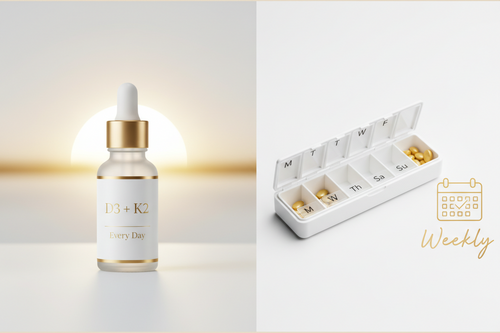
D3X is 2,000 IU per serving for exactly that reason. Not a megadose. A steady daily amount you can actually stick with.
The one real caveat: if you think you're low, or you're in one of the higher-need groups above, the right move is a blood test and a conversation with your doctor. Your starting level changes the answer, and the only way to know your level is to measure it.
And whatever you take, take it with a meal that has some fat in it. Vitamin D absorbs better with food containing fat, which is part of why D3X uses an olive oil base.
600 to 800 to get by. Up to 2,000 to stay steady. 4,000 is the ceiling, not the target.
Sources
NIH Office of Dietary Supplements. "Vitamin D: Fact Sheet for Consumers." 2025.
Demay MB, et al. "Vitamin D for the Prevention of Disease: An Endocrine Society Clinical Practice Guideline." The Journal of Clinical Endocrinology and Metabolism, 2024.
Liu et al. "Vitamin D deficiency and insufficiency among US adults: prevalence, predictors and clinical implications." British Journal of Nutrition, 2018.
Mulligan GB, Licata A. "Taking vitamin D with the largest meal improves absorption and results in higher serum levels of 25-hydroxyvitamin D." Journal of Bone and Mineral Research, 2010.
Frequently Asked
How much vitamin D should I take per day?
For most healthy adults, the recommended dietary allowance is 600 to 800 IU per day, and the safe upper limit is 4,000 IU, according to the NIH. A daily dose between the RDA and about 2,000 IU is a sensible maintenance amount for most people. If you think you may be deficient, get tested and talk to your doctor.
Is 2,000 IU of vitamin D a lot?
No. 2,000 IU per day sits above the recommended allowance and well below the 4,000 IU upper limit set by the NIH, which makes it a reasonable daily maintenance dose for most adults. Products selling 5,000 to 10,000 IU are far more than most people need day to day.
Can you take too much vitamin D?
Yes. Vitamin D is fat-soluble and builds up in the body, so the NIH sets a tolerable upper limit of 4,000 IU per day for adults. Toxicity is rare but can occur at very high intakes sustained over months. More is not better.
Do I need a vitamin D blood test?
Not everyone does, and the 2024 Endocrine Society guideline suggested against routine testing in otherwise healthy adults. But if you suspect you're low or fall into a higher-need group, a 25(OH)D blood test is the only way to know your actual level, and it's worth discussing with your doctor.