No. SAD lamps, also called light therapy boxes, are designed to filter out ultraviolet light, and ultraviolet B is the only kind of light that makes vitamin D in your skin. A light box can sit on your desk every morning all winter and your vitamin D level won't move.
That surprises a lot of people, because light boxes and vitamin D both come up as winter essentials. They do completely different things. Here's why, and what actually covers your vitamin D when the days get short.
Key takeaways
- Your skin makes vitamin D only from UVB light, a narrow band of roughly 290 to 315 nanometers.
- Mayo Clinic advises that light boxes for SAD should filter out most or all UV light. The standard recommendation is 10,000 lux of visible light.
- Light therapy works through visible light reaching the eyes, not UV light on the skin.
- Tanning beds emit mostly UVA, and the WHO's cancer agency classifies UV tanning devices as carcinogenic to humans.
- Above roughly 37 degrees latitude, winter sun makes little or no vitamin D either, so a daily supplement is the reliable source until spring.
HOW DOES YOUR BODY MAKE VITAMIN D FROM LIGHT?
Only one slice of the light spectrum does it. Ultraviolet B, a narrow band of roughly 290 to 315 nanometers, converts a cholesterol-like molecule in your skin into previtamin D3, which your body then turns into vitamin D3. Visible light doesn't do it. Ultraviolet A, the longer wavelength behind tanning and much of the warmth of sunlight, doesn't do it either.
So the question for any lamp, bulb or bed is simple: does it put UVB on your skin? We went deeper into the sun side of this in can you get enough vitamin D from the sun.
WHY DON'T SAD LAMPS PRODUCE VITAMIN D?
Because they're deliberately built not to. According to Mayo Clinic, light boxes for SAD should be designed to filter out most or all UV light, both to protect your eyes and your skin. What they deliver instead is bright visible light, usually recommended at 10,000 lux.
That's because light therapy works through a different route entirely. The Center for Environmental Therapeutics, which specializes in light therapy, explains that it acts through visible light reaching the retina of the eye, not UV light on the skin. Adding or removing UV makes no difference to how a light box works, so manufacturers take it out.
| Light source | Main output | Makes vitamin D? |
|---|---|---|
| SAD lamp / light therapy box | Bright visible light, UV filtered out | No |
| "Daylight" or "full-spectrum" LED bulb | Visible light at a cooler color temperature | No |
| Sunlight through a window | Visible light and UVA; glass blocks UVB | No |
| Tanning bed | Mostly UVA | Little, with serious skin risk |
| Midday summer sun on bare skin | Includes UVB | Yes |
| Winter sun above about 37°N | UVB mostly filtered out by the atmosphere | Little or none |
DO "DAYLIGHT" OR FULL-SPECTRUM BULBS GIVE YOU VITAMIN D?
No. "Daylight" on a bulb describes its color temperature, the cool, bluish-white look of the light, not whether it emits ultraviolet. Ordinary household LED bulbs, whatever the label says, don't put out the UVB your skin needs.
CAN YOU GET VITAMIN D THROUGH A WINDOW?
No. Window glass blocks UVB, so a bright, sunny spot by the window warms you up without making any vitamin D. The same goes for the sun through your car windshield. And in winter, it wouldn't matter much anyway. The classic 1988 study behind the term "vitamin D winter" found that skin in Boston produced no measurable vitamin D from sunlight from November through February, even on clear days outdoors.
DO TANNING BEDS GIVE YOU VITAMIN D?
Some, but they're a poor way to get it. Tanning beds emit mostly UVA, which tans without making vitamin D. Whatever UVB they do emit comes with a serious cost: the International Agency for Research on Cancer, part of the World Health Organization, classifies UV-emitting tanning devices as carcinogenic to humans, its highest category. Mayo Clinic also points out that tanning beds are not an alternative to light therapy, since light therapy relies on visible light, not UV.
Getting vitamin D shouldn't mean trading one problem for another. A daily dose gets you there without the UV exposure.
ARE THERE LAMPS THAT DO MAKE VITAMIN D?
Yes, but they're a different kind of device from a SAD lamp. Lamps that emit UVB exist, including the ultraviolet phototherapy used in dermatology. Mayo Clinic notes that lamps used for skin conditions mainly produce UV light and can damage your eyes if used incorrectly. Any light strong enough to make vitamin D in skin is also strong enough to burn it, so these lamps come with the same trade-off as the sun, just indoors. For most people, a measured daily dose is simpler, cheaper and doesn't require timing your skin exposure.
WHY DOES IT MATTER IN WINTER?
Because winter is exactly when your natural source shuts off. Above roughly 37 degrees latitude, a line that runs near San Francisco, Las Vegas and Richmond, Virginia, the sun sits too low from late fall to late winter for its UVB to reach the ground. Most of the US population lives north of that line.
Your levels reflect that. A 2013 analysis of 3.4 million blood samples sent to the Mayo Clinic from across the US found that vitamin D levels peak in August and hit their lowest point in February, every year. Circulating vitamin D has a half-life of about 15 days, so the drop starts soon after the sun weakens. We mapped out the timeline in when to start taking vitamin D for winter.
A light box brightens your morning. It doesn't touch your vitamin D. Winter needs both covered separately.
HOW TO COVER VITAMIN D IF YOU USE A LIGHT BOX
If you use a light box, you already have the perfect habit to attach vitamin D to. Mayo Clinic's typical guidance is to use a light box within the first hour after waking, for about 20 to 30 minutes. That's a fixed moment, every morning, all winter.
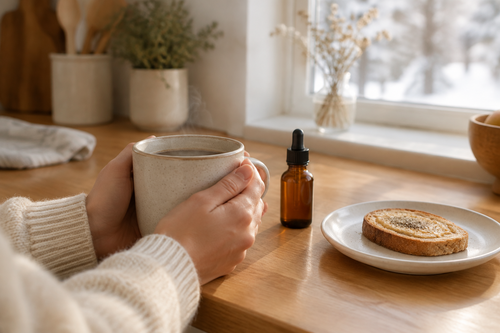
Take your vitamin D in the same sitting. Put a dropper in your morning coffee while you sit at the lamp, and you've tied a new habit to one that's already there. Habit research suggests that's the most reliable way to make something stick. We wrote about exactly this in can you put vitamin D in your coffee.
That's how D3X vitamin D3 + K2 is meant to be used. Three ingredients: vitamin D3, vitamin K2 as MK-7, and organic olive oil. One 1 mL dropper delivers 2,000 IU of D3 and 100 mcg of K2, and because it's already in olive oil, the fat that drives absorption comes with every dose.* No UV, no timing your skin, no guessing whether the sun is high enough.
The light box handles the light. D3X handles the vitamin D. And the D3X subscription keeps a bottle arriving through the darkest months, so you're covered from now until the sun comes back.
*These statements have not been evaluated by the Food and Drug Administration. This product is not intended to diagnose, treat, cure, or prevent any disease.
Sources
Mayo Clinic Staff. "Seasonal affective disorder treatment: Choosing a light box." Mayo Clinic.
Mayo Clinic. "Mayo Clinic Q and A: Light therapy for seasonal affective disorder." Mayo Clinic News Network.
Center for Environmental Therapeutics. "Seasonal affective disorder."
Linus Pauling Institute, Oregon State University. "Vitamin D and Skin Health."
Webb AR, Kline L, Holick MF. "Influence of season and latitude on the cutaneous synthesis of vitamin D3." Journal of Clinical Endocrinology & Metabolism, 1988.
Kasahara AK, Singh RJ, Noymer A. "Vitamin D (25OHD) serum seasonality in the United States." PLOS ONE, 2013.
International Agency for Research on Cancer. IARC Monographs Volume 100D: Solar and ultraviolet radiation (UV-emitting tanning devices classified as Group 1, carcinogenic to humans), 2009.
Frequently Asked
Do SAD lamps give you vitamin D?
No. Mayo Clinic advises that light boxes for SAD should filter out most or all UV light, and only UVB light makes vitamin D in skin. Light therapy works through visible light reaching the eyes, so it doesn't change your vitamin D level.
What kind of light makes vitamin D?
Only ultraviolet B, a narrow band of roughly 290 to 315 nanometers, converts a molecule in your skin into previtamin D3. Visible light and UVA, the wavelength behind tanning, don't make vitamin D.
Do daylight or full-spectrum bulbs give you vitamin D?
No. 'Daylight' describes a bulb's color temperature, not ultraviolet output. Ordinary household LED bulbs don't emit the UVB your skin needs to make vitamin D.
Can you get vitamin D through a window?
No. Window glass blocks UVB, so sitting in a sunny spot indoors or in a car doesn't make vitamin D. In winter above about 37 degrees latitude, outdoor sun makes little or none either.
Do tanning beds give you vitamin D?
Tanning beds emit mostly UVA, which doesn't make vitamin D, and the World Health Organization's cancer agency classifies UV tanning devices as carcinogenic to humans. They're a poor way to get vitamin D.
How do I get vitamin D in winter if I use a light box?
Take a daily vitamin D supplement. Mayo Clinic's typical guidance is to use a light box within the first hour after waking, which makes it an easy moment to take your vitamin D every morning, for example in your coffee.