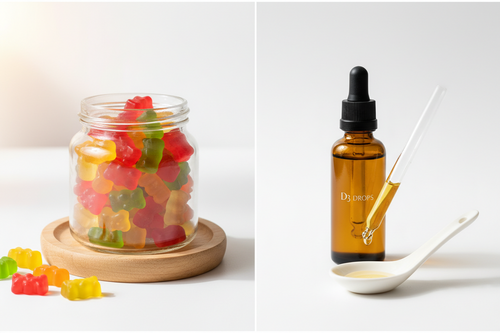
Liquid and capsule vitamin D can both work. But which one absorbs better depends less on liquid versus pill and more on a single thing: the carrier the vitamin is dissolved in. Oil-based forms absorb best.
That's the short answer. The longer one is more useful, because the format on the front of the bottle hides the variable that actually matters.
WHICH FORM OF VITAMIN D IS BEST?
| Form | Carrier | Absorption | What else is in it |
|---|---|---|---|
| Liquid drops in oil | Oil, built in | Highest peak and total absorption in head-to-head testing | Just the carrier oil |
| Oil-filled softgel | Oil, inside a shell | Absorbs well, oil-based | Gelatin or vegetarian shell |
| Tablet | None | Weaker, nothing to carry it | Binders, fillers, coatings |
| Gummy | None | Weakest, no fat carrier | Sugar, gelling agents, colors, flavors |
Oil-based forms sit on one side of the line and dry forms sit on the other. Liquid drops and oil-filled softgels are the two worth choosing between. Tablets and gummies are the compromise.
THE REAL VARIABLE IS THE CARRIER
Vitamin D is fat-soluble, so whatever surrounds it changes how much reaches your blood. In one study in the Journal of Bone and Mineral Research, simply taking vitamin D with a fatty meal raised blood levels by about 50% versus an empty stomach. Fat is the vehicle.
That's why an oil-based form, whether liquid drops in oil or an oil-filled softgel, has an edge over a dry tablet, powder, or gummy. The dry forms give the vitamin nothing to ride in on. We covered this in the best time to take vitamin D, and the same principle carries over: format follows fat.
WHAT THE HEAD-TO-HEAD RESEARCH SHOWS
When researchers compare forms directly, liquid tends to come out slightly ahead. An open-label study of 70 adults in the International Journal of Basic & Clinical Pharmacology compared a vitamin D3 oral solution against a capsule and a tablet. All three were broadly equivalent, but the liquid solution reached a higher peak and delivered greater total absorption than the capsule or tablet.
Not a landslide. A measurable edge. Liquid also doesn't have to be broken down in the gut the way a solid pill does, which is part of why it tends to absorb a little faster.
WHERE LIQUID PULLS AHEAD
Absorption aside, liquid drops win on the things that decide whether you keep taking it, and on what's in the bottle to begin with:
- Fewer ingredients. A tablet needs binders and fillers to hold its shape, and a softgel needs a gelatin or vegetarian shell just to exist as a capsule. None of that is the vitamin. A liquid in oil skips all of it, which is how D3X stays at three ingredients: D3, K2, and organic olive oil.
- No pill to swallow. If you dislike capsules or struggle with them, drops remove the problem entirely.
- Flexible dosing. You adjust by drops instead of being locked to whatever's pressed into a tablet.
- No water needed. A dropper into your mouth or your coffee, done.
IS LIQUID VITAMIN D BETTER THAN A SOFTGEL?
Only slightly, and not for the reason most people assume. Both are oil-based, so both clear the bar that matters most for absorption. The difference is what surrounds the oil.
A softgel needs a shell to hold its shape, usually gelatin or a vegetarian equivalent, plus glycerin and often a colorant. That shell is not the vitamin and not the carrier. It exists so the oil can be a capsule. A liquid in oil skips the shell entirely, which is why a drops-based product can run at three ingredients where a softgel usually can't. D3X is D3, K2 as MK-7, and organic olive oil, with nothing added to make it hold a shape.
The other difference is dose control. A softgel gives you what's inside it. Drops let you adjust.
WHERE CAPSULES ARE PERFECTLY FINE
A capsule isn't the enemy. An oil-filled softgel is also an oil-based form, so it absorbs well, even if its shell is extra material a liquid doesn't need. If you prefer a softgel, a clean one is a solid choice.
The weak options are the dry tablet with no fat, and the gummy, which usually trades absorption for sugar and a longer ingredient list. The real split runs along a different line: oil-based forms on one side, dry and fillered ones on the other.
WHAT ABOUT VITAMIN D SPRAYS AND SUBLINGUAL DROPS?
Sprays and sublingual products are usually marketed on the idea that they bypass digestion and get absorbed straight through the tissue under the tongue. It's an appealing pitch. The evidence behind it is thinner than the marketing suggests.
Vitamin D is fat-soluble, and fat-soluble nutrients are absorbed in the small intestine along with dietary fat. That's the pathway the body is built for. Holding a spray under your tongue doesn't change the chemistry of the molecule, and most of what you spray still ends up swallowed and absorbed the usual way.
None of that makes a spray a bad product. It just means the delivery claim is doing more work than the delivery method is. If the spray is oil-based, you're in fine shape. If it's water or alcohol based, you've given up the fat carrier for a mechanism that isn't clearly doing anything.
DOES LIQUID VITAMIN D NEED TO BE REFRIGERATED?
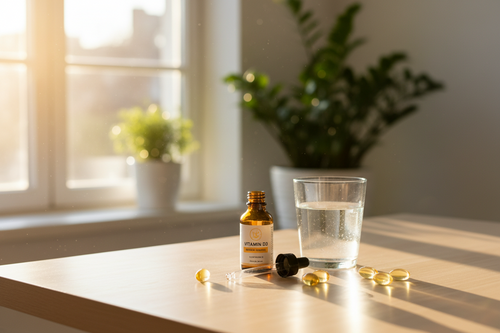
Generally no. An oil-based liquid vitamin D is shelf stable at room temperature. What it doesn't like is heat and light, which is the actual storage question worth asking.
Store it somewhere cool and out of direct sun. A cupboard is fine. A windowsill is not. Packaging helps here too: amber or dark glass blocks light in a way clear plastic doesn't, which is part of why D3X ships in a glass bottle rather than a plastic one.
Check the date on the bottle and use it within the window printed there. If an oil ever smells sharp or off, don't use it.
WHAT IT COMES DOWN TO
The best-absorbed vitamin D is an oil-based form you'll take every day without thinking. That's the standard worth applying when you choose a vitamin D supplement.
D3X is liquid D3 and K2 in organic olive oil. The fat carrier that drives absorption is built into every dropper, there's no pill to swallow, the dose is precise, and it goes down with or without food. The form that absorbs best, in the version you're most likely to stick with.
Oil-based beats dry. And the form you'll keep taking beats the one you won't.
Sources
"Relative oral bioavailability of three formulations of vitamin D3: an open-label, three-treatment study." International Journal of Basic & Clinical Pharmacology.
Bano A, et al. "A comparative absorption study of orodispersible vitamin D3 vs. a chewable tablet and soft gel capsule in adults with vitamin D deficiency." Frontiers in Nutrition, 2023.
Mulligan GB, Licata A. "Taking vitamin D with the largest meal improves absorption and results in higher serum levels of 25-hydroxyvitamin D." Journal of Bone and Mineral Research, 2010.
Frequently Asked
Is liquid or capsule vitamin D better?
Both can work. Absorption depends more on the carrier than the format: oil-based forms, such as liquid drops in oil or oil-filled softgels, absorb best. In one head-to-head study, a liquid vitamin D solution reached a higher peak and greater total absorption than a capsule or tablet.
Does liquid vitamin D absorb better than pills?
Slightly. An open-label study of 70 adults found a vitamin D3 oral solution had a higher peak and total absorption than a capsule or tablet, though all three were broadly comparable. Liquid also doesn't need to be broken down in the gut the way a solid does.
What is the most absorbable form of vitamin D?
An oil-based form, because vitamin D is fat-soluble and absorbs best with fat. Liquid drops in oil and oil-filled softgels both qualify. Dry tablets, powders, and gummies give the vitamin no fat to absorb with.
Are vitamin D gummies a good option?
Gummies are easy to take but usually the weakest choice for absorption, since they lack a fat carrier and often add sugar and a longer ingredient list. An oil-based liquid or softgel is a better bet.
Does liquid vitamin D have fewer ingredients than capsules?
Often, yes. A tablet needs binders and fillers to hold its shape, and a softgel needs a gelatin or vegetarian shell to be a capsule. A liquid in oil is just the vitamin and its carrier oil. D3X has three ingredients: vitamin D3, vitamin K2 as MK-7, and organic olive oil.
Do liquid vitamin D drops need to be refrigerated?
Generally no. Oil-based liquid vitamin D is shelf stable at room temperature. Keep it cool and out of direct sunlight rather than refrigerated. Dark or amber glass protects the oil from light better than clear plastic. Use it within the date printed on the bottle.
Are vitamin D sprays better than drops?
Not clearly. Sprays are marketed on bypassing digestion, but vitamin D is fat-soluble and is absorbed in the small intestine along with dietary fat. An oil-based spray works fine. A water or alcohol based one gives up the fat carrier without a clear benefit in return.