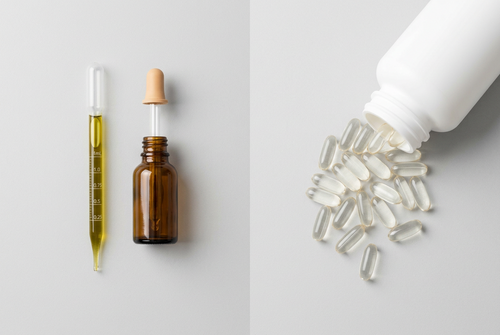
One microgram (mcg) of vitamin D equals 40 IU. So 1,000 IU is 25 mcg, 2,000 IU is 50 mcg, and the 50,000 IU prescription dose is 1,250 mcg, or 1.25 mg. Since the FDA's 2016 labeling rules, Supplement Facts panels must list vitamin D in mcg, with IU optional in parentheses, which is why the same dose looks different on different bottles.
The short version:
- IU to mcg: divide by 40. Mcg to IU: multiply by 40.
- 1 mg = 1,000 mcg = 40,000 IU.
- The adult RDA is 15 mcg (600 IU); the upper limit is 100 mcg (4,000 IU).
- "2,000 mg of vitamin D" is almost always a typo for 2,000 IU.
- Blood test units are different again: ng/mL and nmol/L measure your level, not your dose.
- No math needed: one marked D3X dropper is 50 mcg (2,000 IU); half is 25 mcg (1,000 IU).
VITAMIN D IU TO MCG CONVERSION CHART
| IU | mcg | mg | Where you see it |
|---|---|---|---|
| 400 IU | 10 mcg | 0.01 mg | Many multivitamins |
| 600 IU | 15 mcg | 0.015 mg | Adult RDA, ages 19 to 70 |
| 800 IU | 20 mcg | 0.02 mg | RDA over 70; the FDA Daily Value |
| 1,000 IU | 25 mcg | 0.025 mg | Common low-dose supplement |
| 2,000 IU | 50 mcg | 0.05 mg | The dose used in the VITAL trial; one dropper of D3X |
| 4,000 IU | 100 mcg | 0.1 mg | Adult upper limit |
| 5,000 IU | 125 mcg | 0.125 mg | Common high-dose supplement |
| 10,000 IU | 250 mcg | 0.25 mg | High dose, usually short term with a doctor |
| 50,000 IU | 1,250 mcg | 1.25 mg | Weekly prescription dose |
HOW DO YOU CONVERT IU TO MCG?
Divide by 40. The NIH defines the biological activity of 40 IU of vitamin D as equal to 1 mcg. So 3,000 IU is 75 mcg, and 1,500 IU is 37.5 mcg. Going the other way, multiply mcg by 40: a label that says 50 mcg is 2,000 IU. The same factor works for D3 (cholecalciferol) and D2 (ergocalciferol).
WHY DID VITAMIN D LABELS SWITCH TO MCG?
Because the FDA changed the rules. Under the 2016 Nutrition and Supplement Facts updates, vitamin D must be declared in micrograms, and IU may be added in parentheses after it. That's why a newer bottle reads "50 mcg (2,000 IU)" while older labels, doctors and most articles still talk in IU. Same vitamin, same dose, different unit.
One more number on the label: the % Daily Value. The FDA's Daily Value for vitamin D is 20 mcg (800 IU), so a 50 mcg dose shows as 250%. That isn't a warning, it's just the math. The safety line is the upper limit, 100 mcg (4,000 IU) for adults.
50 mcg, 2,000 IU, 0.05 mg. Three ways to write the same dropper.
IS 2,000 MG OF VITAMIN D TOO MUCH?
It would be, if it existed. A milligram is 1,000 micrograms, so 2,000 mg of vitamin D would be 80 million IU. No supplement contains that. When someone writes "2,000 mg" or "5,000 mg" of vitamin D, they almost always mean IU. If you're unsure, the Supplement Facts panel on the bottle shows the real units. Mg does show up legitimately in one place: prescription 50,000 IU capsules are sometimes labeled 1.25 mg. We explain that dose in what 50,000 IU of vitamin D is actually for.
IS A NG/ML BLOOD RESULT THE SAME AS A DOSE?
No, and this trips people up. IU, mcg and mg describe how much vitamin D you take. Your blood test result, in ng/mL or nmol/L, describes the level in your blood. They don't convert into each other. To switch between the two blood units, divide nmol/L by 2.5 to get ng/mL. What the result means is covered in vitamin D blood test: what the numbers mean.
HOW MUCH VITAMIN D SHOULD YOU TAKE, IN MCG?
The adult RDA is 15 mcg (600 IU) a day, rising to 20 mcg (800 IU) after 70, with an upper limit of 100 mcg (4,000 IU). Most adult supplements sit at 25 to 50 mcg (1,000 to 2,000 IU). In the VITAL trial, 25,871 adults took 50 mcg (2,000 IU) a day for over five years with no safety signal. To pick your dose, see how much vitamin D should you take and 2,000 IU vs 5,000 IU.
WHAT ABOUT K2? DOES IT HAVE IU?
No. Vitamin K2 is only ever measured in micrograms. A typical dose alongside vitamin D is around 100 mcg of K2 as MK-7. Our post on vitamin D3 and K2 explains why they're paired.
WHY D3X
The easiest way to never convert units again: one marked 1 mL dropper of D3X is 50 mcg (2,000 IU) of D3, and half a dropper is 25 mcg (1,000 IU). No pills to split, no math. And everything else is built to make it the obvious choice:
- The dose the research uses: 2,000 IU (50 mcg) of D3, the daily dose 25,871 adults took for over five years in the VITAL trial, at half the upper limit.
- K2 built in: 100 mcg of K2 as MK-7, which helps direct calcium to bone.*
- The fat comes with it: dissolved in organic olive oil, so absorption doesn’t depend on what you ate.
- Nothing else: three ingredients, no seed oils, fillers or sweeteners, in amber glass.
- Checked: made in the USA in a cGMP facility and third-party tested.
- Easy to keep going: from 75¢ a day, free US shipping, and a subscription so you never run out.
Get D3X Liquid Vitamin D3 + K2 →
Sources
National Institutes of Health, Office of Dietary Supplements. "Vitamin D: Fact Sheet for Health Professionals."
US Food and Drug Administration. "FDA Provides Guidance for Industry to Convert Units of Measure for Certain Nutrients on the Nutrition and Supplement Facts Labels." 2019.
Manson JE, et al. "Vitamin D Supplements and Prevention of Cancer and Cardiovascular Disease." New England Journal of Medicine, 2019 (VITAL).
About D3X. D3X makes one thing: a liquid vitamin D3 + K2 (2,000 IU D3 / 100 mcg K2 as MK-7) in an olive-oil base, third-party tested and made in the USA. No seed oils, fillers, or sweeteners. See the liquid vitamin D3 + K2 drops.
*These statements have not been evaluated by the Food and Drug Administration. This product is not intended to diagnose, treat, cure, or prevent any disease.
Frequently Asked
How do you convert vitamin D IU to mcg?
Divide IU by 40. One microgram of vitamin D equals 40 IU, so 1,000 IU is 25 mcg, 2,000 IU is 50 mcg and 5,000 IU is 125 mcg. To go from mcg to IU, multiply by 40.
How many IU is 25 mcg of vitamin D?
1,000 IU. 25 mcg multiplied by 40 equals 1,000.
How many IU is 50 mcg of vitamin D?
2,000 IU. 50 mcg multiplied by 40 equals 2,000.
How many IU is 125 mcg of vitamin D?
5,000 IU. 125 mcg multiplied by 40 equals 5,000. That's above the 4,000 IU (100 mcg) adult upper limit.
How many mg is 50,000 IU of vitamin D?
1.25 mg, which is 1,250 mcg. That's the weekly prescription dose, written on some labels as 1.25 mg.
Is 2,000 mg of vitamin D safe?
Almost certainly the label means 2,000 IU, not mg. 2,000 IU is 50 mcg, a normal daily dose. 2,000 mg would be 80 million IU, which no supplement contains. Check the Supplement Facts panel for the units.
Why do vitamin D labels now say mcg instead of IU?
The FDA's 2016 labeling rules require vitamin D to be listed in micrograms on Nutrition and Supplement Facts labels. Manufacturers may still show IU in parentheses after the mcg amount.
What is the upper limit of vitamin D in mcg?
100 mcg (4,000 IU) a day for adults, according to the NIH. The adult RDA is 15 mcg (600 IU), rising to 20 mcg (800 IU) after 70.