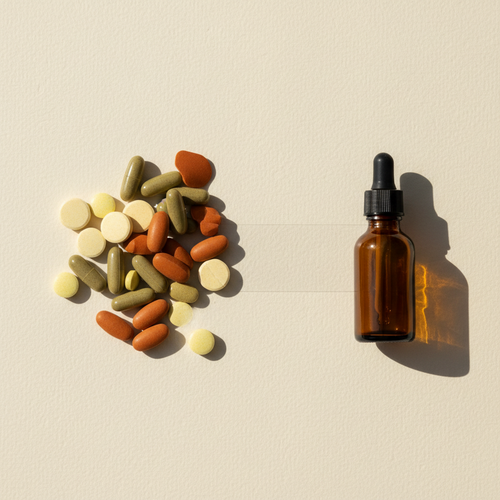
For most adults, 2,000 IU of vitamin D3 a day is the right maintenance dose: enough to raise and hold a healthy blood level, half the 4,000 IU upper limit, and the dose with the longest safety record in large trials. 5,000 IU a day is above the upper limit, and it is the right call only for some people, usually with a blood test behind it and a doctor's nod. The shelf is full of 5,000 IU bottles because a bigger number sells, not because most people need it.
The short version:
- The NIH upper limit for adults is 4,000 IU a day. 5,000 IU sits above it; 2,000 IU sits at half.
- 2,000 IU a day was taken for more than five years by 25,871 adults in the VITAL trial with no increase in high calcium or kidney stones.
- Each 1,000 IU a day raises blood 25(OH)D by roughly 6 to 10 ng/mL in an average adult, less in heavier people.
- 5,000 IU makes sense for people who are tested low, carry significant extra weight, or have absorption problems, with follow-up testing.
- Daily consistency moves levels more reliably than a bigger dose taken sometimes.
WHAT'S THE DIFFERENCE BETWEEN 2,000 IU AND 5,000 IU OF VITAMIN D?
| 2,000 IU a day | 5,000 IU a day | |
|---|---|---|
| Against the NIH upper limit (4,000 IU) | Half of it | Above it |
| Typical rise in blood level | About 12 to 20 ng/mL over 2 to 3 months | About 30 to 50 ng/mL over 2 to 3 months |
| Who it suits | Most adults for year-round maintenance | People tested low, with higher body weight, or with malabsorption, under supervision |
| Long-term safety data | VITAL: 25,871 adults, median 5.3 years, no safety signal | Shorter studies; generally well tolerated but above the limit set for unsupervised use |
| Needs a blood test? | Helpful, not required | Yes, before and after |
The blood-level figures are averages. A dose-response study by Heaney and colleagues found that each additional 1,000 IU a day raised 25(OH)D by roughly 7 ng/mL once levels settle, with wide variation between people. Body weight is the biggest reason: vitamin D is stored in fat, so the same dose produces a smaller rise in a larger body.
IS 2,000 IU OF VITAMIN D ENOUGH?
For most adults who are not already deficient, yes. It is well above the 600 to 800 IU recommended dietary allowance, it raises a typical adult from the low 20s into the 30s ng/mL over a few months, and it is the dose the largest long-term trial used. In VITAL, 25,871 adults aged 50 and over took 2,000 IU of D3 or placebo daily for a median of 5.3 years. The vitamin D group showed no increase in high blood calcium or kidney stones, which are the two things that go wrong with too much vitamin D. We went through the safety question in is 2,000 IU of vitamin D3 a day safe.
Where 2,000 IU may not be enough: if a blood test shows you well below 20 ng/mL, if you carry significant extra weight, if you have a condition that affects fat absorption, or if you rarely see the sun and live in the north. Those are the people the 5,000 IU bottle was made for.
IS 5,000 IU OF VITAMIN D TOO MUCH?
It is above the 4,000 IU tolerable upper intake level, which the NIH defines as the highest daily amount unlikely to cause harm in almost everyone. That does not make 5,000 IU dangerous; documented toxicity involves 50,000 IU or more a day for months, as we covered in can you take too much vitamin D. It does mean 5,000 IU is a dose to take on purpose, with a reason, rather than because it was the bottle on the shelf.
The Endocrine Society's clinical guidance has long noted that adults with obesity may need two to three times the usual intake to reach the same blood level, and that is the legitimate case for 5,000 IU. A blood test before and three months after tells you whether it is working and whether to come back down.
WHY DO MOST BOTTLES SAY 5,000 IU?
Because a bigger number looks like a better deal, and because 5,000 IU softgels cost almost nothing more to make than 2,000 IU ones. The category is sold on potency. Vitamin D does not work that way: it is fat-soluble, it accumulates, and your level reflects months of intake rather than today's dose. The useful comparison is not 2,000 versus 5,000 on the label. It is whether you took it every day for the last ninety.
Your blood level is the average of the last three months, not the number on the bottle. A dose you take every day beats a bigger one you take sometimes.
WHAT ABOUT 1,000 IU, OR 10,000 IU?
1,000 IU is a reasonable dose for someone who gets regular sun or eats oily fish several times a week; for an indoor adult in a northern winter it often does not move the number much. 10,000 IU a day is two and a half times the upper limit and belongs to supervised correction protocols, not to a bottle you buy without a test. If you have been prescribed a high weekly dose, that is a different thing again: what 50,000 IU of vitamin D is for explains it, including what to take once the course ends.
HOW TO PICK YOUR DOSE
- No test, generally healthy, normal weight: 2,000 IU a day, every day. Retest or not; you are within the range the long-term data covers.
- Tested low (under 20 ng/mL), or carrying significant extra weight: talk to your provider about 4,000 to 5,000 IU for two to three months, then retest and settle to a maintenance dose.
- Tested fine (30 ng/mL or above): 1,000 to 2,000 IU to stay there through the winter.
- Either way: take it with fat, or in an oil-based form that brings its own, and take it daily. How much vitamin D should you take has the full breakdown by age and situation.
WHY D3X IS 2,000 IU
We chose the dose with the best evidence for daily, year-round use by most adults, and built the product around taking it every day. D3X Liquid Vitamin D3 + K2 delivers 2,000 IU of D3 and 100 mcg of K2 as MK-7 in one marked 1 mL dropper of organic olive oil, so the fat the vitamin needs comes with the dose. If your doctor wants you higher for a while, a liquid makes that easy: a second dropper is 4,000 IU, without buying a different product, and you come back down to one when the retest says so. Three ingredients, 30 servings, amber glass. The dose most people should be taking, in the form most people will keep taking.
Sources
National Institutes of Health, Office of Dietary Supplements. "Vitamin D: Fact Sheet for Health Professionals."
Manson JE, et al. "Vitamin D Supplements and Prevention of Cancer and Cardiovascular Disease." New England Journal of Medicine, 2019 (VITAL, n=25,871).
Heaney RP, et al. "Human serum 25-hydroxycholecalciferol response to extended oral dosing with cholecalciferol." American Journal of Clinical Nutrition, 2003.
Holick MF, et al. "Evaluation, treatment, and prevention of vitamin D deficiency: an Endocrine Society clinical practice guideline." Journal of Clinical Endocrinology & Metabolism, 2011.
Institute of Medicine. "Dietary Reference Intakes for Calcium and Vitamin D." National Academies Press, 2011.
About D3X. D3X makes one thing: a liquid vitamin D3 + K2 (2,000 IU D3 / 100 mcg K2 as MK-7) in an olive-oil base, third-party tested and made in the USA. No seed oils, fillers, or sweeteners. See the liquid vitamin D3 + K2 drops.
This article is general information, not medical advice. Doses above 4,000 IU a day are a decision to make with your healthcare provider and a blood test.
*These statements have not been evaluated by the Food and Drug Administration. This product is not intended to diagnose, treat, cure, or prevent any disease.
Frequently Asked
Should I take 2,000 IU or 5,000 IU of vitamin D?
For most adults, 2,000 IU a day: it is half the NIH upper limit of 4,000 IU and was taken daily for over five years by 25,871 adults in the VITAL trial with no safety signal. 5,000 IU sits above the upper limit and suits people who test low, carry significant extra weight, or have absorption problems, ideally with a blood test before and after.
Is 5,000 IU of vitamin D too much?
It is above the 4,000 IU tolerable upper intake level, which the NIH defines as the highest daily amount unlikely to cause harm in almost everyone. Documented toxicity involves 50,000 IU or more a day for months, so 5,000 IU is not dangerous, but it is a dose to take on purpose with a reason and follow-up testing.
Is 2,000 IU of vitamin D enough?
For most adults who are not deficient, yes. It is well above the 600 to 800 IU RDA and raises a typical adult's blood level by roughly 12 to 20 ng/mL over two to three months. People who are tested very low, carry extra weight, or have malabsorption may need more for a period.
How much does 5,000 IU raise vitamin D levels?
On average, each 1,000 IU a day raises blood 25(OH)D by roughly 6 to 10 ng/mL once levels settle after two to three months, so 5,000 IU a day typically adds about 30 to 50 ng/mL. The rise is smaller in people with higher body weight.
Why are most vitamin D supplements 5,000 IU?
Because a bigger number sells and costs almost nothing more to make. Vitamin D is fat-soluble and accumulates, so your blood level reflects months of daily intake rather than the number on the bottle.
Can I take 2,000 IU of vitamin D every day long term?
Yes. In the VITAL trial, 25,871 adults took 2,000 IU of D3 daily for a median of 5.3 years with no increase in high blood calcium or kidney stones compared with placebo.