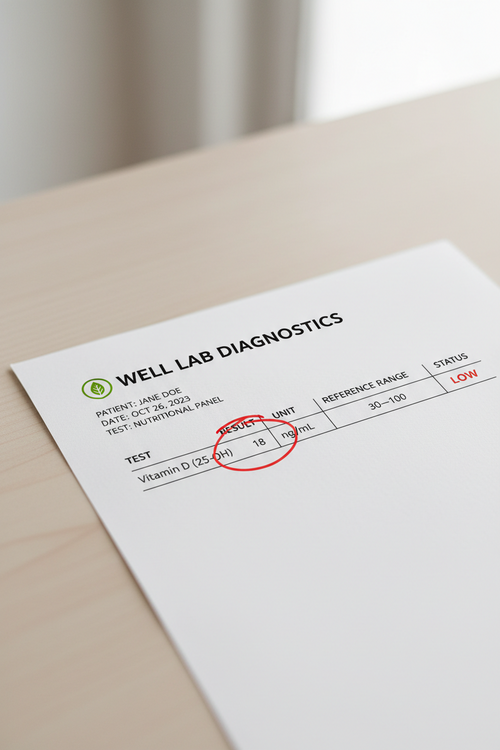
Vitamin D production runs on UVB sunlight hitting bare skin. Five factors of modern life have collectively shut most of that down: indoor schedules, sunscreen and clothing, latitude and season, a thin dietary supply, and stored body fat.
The result: roughly 70% of US adults run below sufficient vitamin D levels according to NHANES data. Here's how each of the five factors plays into it.
1. INDOOR LIVES
Work, commuting, travel, leisure. The default schedule of an adult in any modern city now takes place almost entirely indoors. The window for UVB exposure to skin, which used to mean walking, working, eating, and resting outside, has shrunk to brief transits between buildings and cars.*
This is the largest single factor, and it is not reversible without conscious effort. Even people who exercise regularly often train indoors, or train outdoors under enough sunscreen to block the wavelength that matters.
2. SUNSCREEN AND CLOTHING
The chemistry is exact. Sunscreen with SPF 8 or higher blocks the UVB wavelengths the skin uses to make vitamin D.* That holds regardless of brand and regardless of mineral or chemical formulation. Standard dress (long pants, shirts, hats) further reduces exposed surface area.
Dermatology guidelines correctly recommend protecting skin from UV damage. The unintended consequence is that the body's primary route to vitamin D, which is also via UV, gets shut down at the same time.
3. LATITUDE AND SEASON
A 1988 study by Webb, Kline, and Holick, published in The Journal of Clinical Endocrinology and Metabolism, measured cutaneous vitamin D3 synthesis in winter sunlight in Boston and Edmonton. The finding: winter sunlight at those latitudes was insufficient to promote any meaningful vitamin D synthesis in human skin.*
Holick has put it more directly in interviews. "We showed that in Boston you can't make any vitamin D in your skin from November through March, no matter how long you stay outside," he told Boston University's Bostonia. "In the summertime, you can't make any vitamin D at eight in the morning or at five in the afternoon."
The further north you live, the longer your no-D window. People in Boston, Chicago, Seattle, Toronto, London, Berlin, and most of Northern Europe are looking at a roughly half-year stretch where the sky will not produce vitamin D for them, no matter the lifestyle.
4. THE DIETARY SUPPLY IS THIN
Almost no foods naturally contain meaningful vitamin D. According to the NIH Office of Dietary Supplements, a 3-oz serving of cooked sockeye salmon provides about 447 IU, one large egg about 41 IU, an ounce of Swiss cheese about 6 IU. Fortified milk in the US contains about 120 IU per cup.
The recommended daily intake for adults is 600 to 800 IU. To get there from food alone, the diet would have to look like salmon most days, several glasses of fortified milk, and eggs and fortified cereal on top. Almost no one's actual diet looks like that.
For most populations, food contributes a small fraction of the body's vitamin D supply. It is not a backstop.
5. BODY COMPOSITION
Vitamin D is fat-soluble, which means it dissolves into fat tissue when produced or absorbed.* In people with higher body fat percentages, more of the available vitamin D gets stored in adipose tissue, leaving less in circulation. A 2000 study by Wortsman and Holick, published in the American Journal of Clinical Nutrition, found that obese individuals had a 57% lower rise in circulating vitamin D after UVB exposure compared with lean individuals, despite both groups starting with similar skin-level precursor pools.* The gap came from bioavailability.
The mechanism is debated. Some researchers attribute it to sequestration in fat tissue. Others to simple volumetric dilution across a larger body. The practical outcome is the same: people with higher body fat tend to run lower on vitamin D from the same input.*
ADD IT UP
Indoor schedules cut UVB exposure. Sunscreen and clothing block what little exposure happens. Latitude and season eliminate the input for half the year in much of the country. Diet doesn't fill the gap. And body composition reduces what's bioavailable from whatever does get in.
This is what researchers mean when they call vitamin D a foundational gap, hiding in plain sight. The biology was designed for an outdoor, equatorial-or-nearby existence. Almost no one lives that way anymore.
Time to get serious about your D.
Frequently Asked
Why are so many people low on vitamin D?
Five factors of modern life work together to lower vitamin D levels: indoor schedules that limit UVB exposure to skin, sunscreen and clothing that block UVB even when outdoors, latitude and season that eliminate UVB-driven skin synthesis during winter at higher latitudes, a thin dietary supply since few foods naturally contain meaningful vitamin D, and body composition since stored body fat reduces bioavailability.
Can you make vitamin D in the winter?
It depends on latitude. A 1988 study by Webb, Kline, and Holick published in The Journal of Clinical Endocrinology and Metabolism measured cutaneous vitamin D3 synthesis in winter sunlight in Boston and Edmonton and found that winter sunlight at those latitudes was insufficient to promote any meaningful vitamin D synthesis in human skin. Holick has summarized it as 'in Boston you can't make any vitamin D in your skin from November through March, no matter how long you stay outside.'
Does sunscreen block vitamin D production?
Yes. Sunscreen with SPF 8 or higher blocks the UVB wavelengths the skin uses to make vitamin D. This is true for both mineral and chemical formulations. Standard clothing (long pants, shirts, hats) also reduces exposed surface area available for synthesis.
Can you get enough vitamin D from food?
For most people, no. According to the NIH Office of Dietary Supplements, a 3-oz serving of sockeye salmon provides about 447 IU, a large egg about 41 IU, fortified milk about 120 IU per cup. The recommended daily intake for adults is 600 to 800 IU. To hit that from food alone would require eating salmon most days plus stacking eggs, fortified milk, and fortified cereal. Most diets do not look like that, so food is a small fraction of the supply.
Why do obese individuals tend to have lower vitamin D levels?
Vitamin D is fat-soluble and stores in adipose tissue. A 2000 study by Wortsman and Holick in the American Journal of Clinical Nutrition found that obese individuals had a 57% lower rise in circulating vitamin D after UVB exposure compared with lean individuals, despite both groups having similar skin-level precursor pools. The mechanism is debated between sequestration in fat tissue and simple volumetric dilution across a larger body, but the practical outcome is that people with higher body fat tend to run lower on vitamin D from the same input.