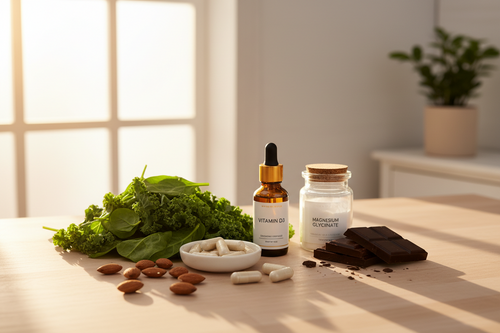
The best time to take vitamin D is in the morning, with a meal that contains some fat. But the timing detail that matters most isn't the hour of the day. It's whether you take it at all, consistently.
Let's take those one at a time.
VITAMIN D NEEDS FAT TO ABSORB
This is the part with the strongest evidence behind it. Vitamin D is fat-soluble, so it absorbs best when there's fat present to carry it in. In one study in the Journal of Bone and Mineral Research, people who took their vitamin D with the largest, fattiest meal of the day raised their blood levels by about 50% compared with taking it on an empty stomach.
That's a real problem for a standard dry pill or tablet. It gives the vitamin nothing to dissolve into, so the only workaround is to remember to pair it with a fatty meal every single time.
This is where the format earns its keep. D3X's D3 and K2 are already dissolved in organic olive oil, so the fat that drives absorption is built into every dose. You're not relying on whatever you happened to eat.
That solves a specific, common problem. If you skip breakfast, or you're in an intermittent-fasting window, a dry pill on an empty stomach absorbs poorly. D3X doesn't have that issue, because it brings its own fat. Take it first thing, fasted, no meal required, and it still has everything it needs to absorb.
WHY MORNING
Morning wins for two reasons, one practical and one biological.
Practically, morning is the easiest time to actually remember. Attach your dose to something you already do without fail, like your first coffee or breakfast, and it stops being a decision you can forget. And because D3X carries its own fat, you can anchor it to your morning whether or not you eat then, even with just black coffee. The Cleveland Clinic suggests something as low-tech as keeping it by the kettle or on the breakfast table.
Biologically, your body would naturally make vitamin D from midday sun, so taking it earlier loosely mirrors that rhythm. There's also a sleep angle: research on taking vitamin D late at night is mixed, with some studies suggesting it may affect melatonin and sleep.* Morning sidesteps the question entirely.
THE PART THAT ACTUALLY MATTERS
Underneath all the timing talk is a simpler truth: the exact hour is a rounding error next to consistency.
Vitamin D works by holding a steady level in your blood. One dose here and there doesn't do much. A dose every day is what keeps your level up. Take it half the time and even the best-formulated supplement barely registers.
This is the thing we care about most at D3X. A great product does nothing sitting in a cupboard. So we built around the habit itself: a sensible daily dose, easy enough to take that you actually keep it up, the kind of thing that becomes as automatic as brushing your teeth.
Which is why the timing advice is really habit advice. Pick one fixed moment, ideally a breakfast with some fat in it, and bolt your vitamin D to it. Same time, same trigger, every day.
The best time to take vitamin D is the time you'll actually remember. Every day.
Sources
Mulligan GB, Licata A. "Taking vitamin D with the largest meal improves absorption and results in higher serum levels of 25-hydroxyvitamin D." Journal of Bone and Mineral Research, 2010.
Cleveland Clinic. "The Best Time of Day To Take Vitamin D." 2025.
Frequently Asked
When is the best time to take vitamin D?
For most people, the best time is in the morning with a meal that contains some fat, which helps absorption. More important than the exact time is taking it consistently, every day.
Should I take vitamin D with food?
If it's a dry pill or tablet, yes. Vitamin D is fat-soluble, so taking it with a meal that contains fat improves absorption. One study found taking it with the largest, fattiest meal raised blood levels by about 50% versus an empty stomach. An oil-based liquid like D3X already includes the fat, so it doesn't depend on a meal.
Can you take vitamin D while intermittent fasting?
Vitamin D needs fat to absorb, which is a problem for a dry pill on an empty stomach. An oil-based liquid like D3X has the fat built in, since the drops are dissolved in olive oil, so it absorbs well even fasted or without a meal.
Is it bad to take vitamin D at night?
It isn't dangerous, but research on nighttime vitamin D and sleep is mixed, with some studies suggesting it may affect melatonin.* Taking it in the morning or midday avoids the question and is easier to keep consistent.
Does the time of day affect how well vitamin D works?
Not much. Research hasn't shown a clear difference between morning and evening for effectiveness. Taking it with food and taking it consistently matter far more than the exact hour.